Home / Products 

Machine Vision Lenses

Industrial lenses selected according to field of view, working distance, resolution, distortion, depth of field, and measurement requirements — the lens decides what the camera can actually see before a single pixel is processed.

The lens decides what's possible before the camera does

A high-resolution sensor behind the wrong lens still produces a soft, distorted, or incorrectly framed image. The lens sets the field of view, how much working distance you have to the part, how sharp the image stays across that field, and how faithfully a measurement in pixels converts back to a real-world dimension.

We select lenses the same way we select cameras — starting from the part, the required accuracy, and the space available on the machine — rather than defaulting to whatever ships with the camera.
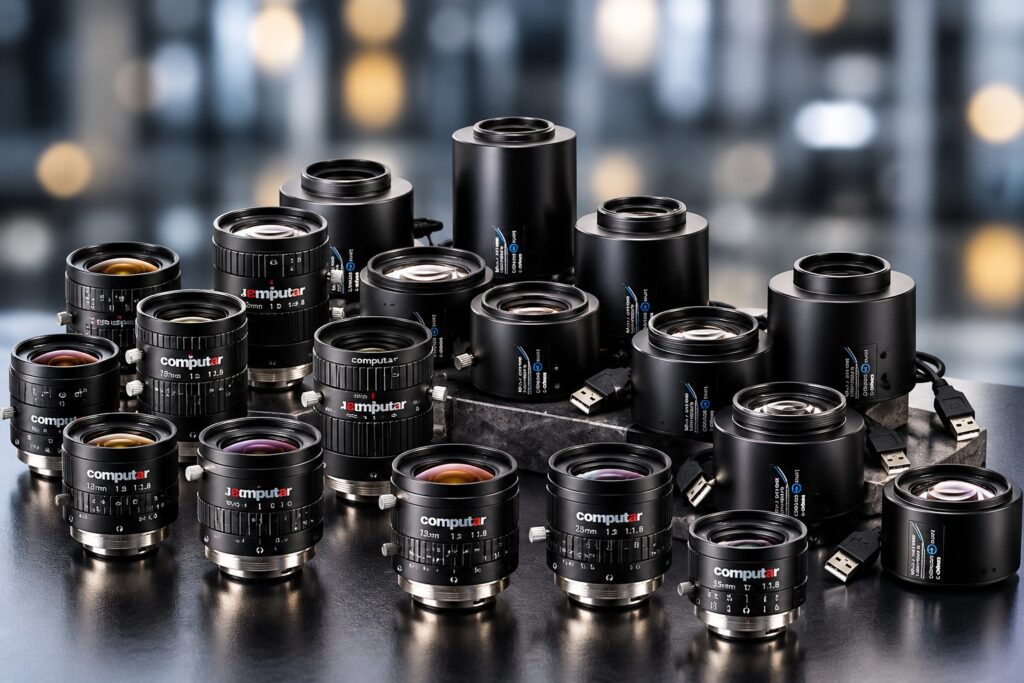
Machine vision lens we supply

Optical quality and consistency from unit to unit matter as much as the camera behind the lens.

Computar

We supply Computar’s range of fixed focal length, macro and telecentric lenses across C-mount and CS-mount formats, matched to your sensor size and inspection requirement.

Six factors that decide the right lens

Every lens we specify is checked against these criteria before it’s paired with a camera and mounted on your line.

Field of View

How much of the part or web needs to be visible in a single frame, at the required detail.

Working Distance

The physical space between the lens and the part, set by the machine’s layout and access.

Resolution Matching

Lens resolving power matched to the sensor’s pixel size, so the sensor isn’t the limiting factor.

Distortion

How straight lines and true dimensions stay near the edges of the frame, not just the center.

Depth of Field

How much the part’s height or position can vary while the image stays acceptably sharp.

Measurement Requirements

Whether the application needs true dimensional accuracy, which points toward a telecentric lens.

Lens types we supply

Every job calls for a different combination of sensor type and connection. Here’s what we specify most often, and why.

Fixed Focal (Entocentric)

Standard machine vision lenses for general inspection, sized by focal length and format.

Macro Lenses

Close-focusing optics for small parts and fine detail at short working distances.

Telecentric Lenses

Constant magnification across the field, near-zero perspective error, for precision measurement.

Motorized / Zoom Lenses

Remote focus, zoom, and iris control for lines running multiple part variants.

Large Format Lenses

Coverage for large sensors used in high-resolution area scan and line scan cameras.

Mounts

C-Mount, CS-Mount, and F-Mount, matched to your camera body and flange distance.

Entocentric or telecentric?

The single most common lens decision on a measurement application.

Entocentric (Standard)

Telecentric

Best for

General inspection and presence checks

Precision dimensional measurement

Perspective error

Present — magnification shifts with distance

Minimal — magnification stays constant

Field of view

Flexible, wide range of options

Fixed to the lens, narrower coverage

Cost & size

Lower cost, more compact

Higher cost, larger and heavier

VERSATILE MACHINE VISION

Industries we supply industrial cameras for

Automotive & Auto Components
Packaging & FMCG
Printing, Film & Web Inspection
Precision Engineering
Electronics & PCB
Pharma & Medical Devices

Not sure which lens fits your camera and part?

Share your field of view, working distance, and accuracy requirement. Our application engineers will match the right lens type, mount, and format to your camera.